
By Ahmed Khan
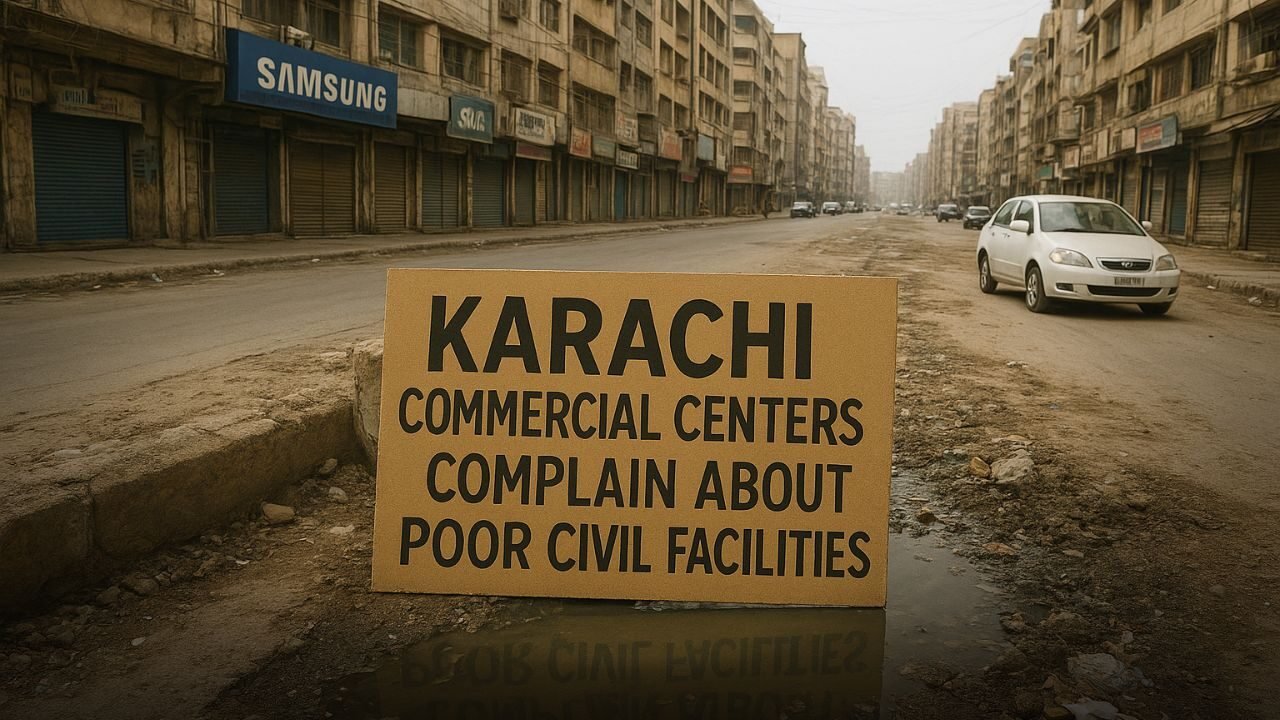
Karachi’s busiest commercial hubs are facing a severe Karachi commercial centers crisis, threatening business activity and driving customers away.
According to this reporter, broken roads, overflowing sewage, erratic power, and poor street maintenance are disrupting daily commerce and pushing costs higher for shopkeepers.
The power outages have made matters worse, severely affecting business operations across the city.
Understanding the Karachi Commercial Centers Crisis
Business leaders report that clogged drains, irregular garbage collection, non-functioning streetlights, and lack of parking have become routine issues.
These problems have worsened in recent months, forcing some businesses to struggle just to stay open.
Saddar Market Faces Blocked Drains and Declining Customers
At Saddar’s famous electronics market, shopkeepers face constant problems with blocked drains spilling wastewater onto the sidewalks.
Customers often tiptoe around puddles or leave without shopping, leading to a sharp drop in foot traffic.
“We spend money from our own pockets to clean the area around our shops, but the problem restarts the next day,” Rizwan Irfan, Chairman of Electronic Market Association, Karachi, told this reporter.
“Customers avoid coming here in the evening because the roads are dark and congested. The streetlights stop working for weeks, hurting business,” he added.
Flooded Streets and Water Shortages in Clifton and Defence
In Clifton and Defence commercial areas, traders face different issues. While the roads are somewhat better maintained, water shortages and malfunctioning drains after rain leave the markets flooded and smelly.
“Every time it rains, stormwater mixes with sewage and floods the streets. Customers don’t want to step out of their cars, let alone walk around,” said Jameel Paracha, a trader in Clifton’s Boat Basin area.
Gulshan-e-Iqbal Traders Struggle with Waste Management
Gulshan-e-Iqbal’s business community is also frustrated by poor waste management and irregular maintenance. Plazas along University Road and nearby commercial strips often see garbage piling up for days.
Shopkeepers said hiring private cleaners increases their costs, adding financial strain. Various trade associations have asked local government departments to take immediate action.
“The city’s economy relies heavily on its commercial centers. Prolonged civic neglect could have long-term consequences,” said Rauf Ibrahim, Chairman of Old City Wholesalers Association.
He warned that worsening conditions might drive customers to online shopping or to organized marketplaces outside Karachi’s traditional hubs. He called for coordinated action from municipal corporations, water and sewerage authorities, and traffic management departments.
Ibrahim also pointed out that poor coordination among city agencies is a major reason civic issues remain unresolved. He urged for regular maintenance schedules, transparent reporting, and dedicated complaint-response systems for commercial zones.
Long Power Outages Threaten Jodia Bazaar Operations
Long power outages remain another major problem. At Jodia Bazaar, Karachi’s largest wholesale market and a key artery for national commerce, business activity has nearly come to a standstill.
Traders warn that unless electricity supply is restored, the consequences could be disastrous locally and nationally.
Speaking to this reporter, Salim Vali Muhammad, Chairman of Pakistan Chemicals & Dyes Merchants Association (PCDMA), said traders cannot comply with mandatory requirements like sales tax e-returns, income tax filings, and e-invoicing due to the unstable electricity supply.
“From inventory management to the FBR’s digital systems, nothing is functioning. It has become nearly impossible to carry out essential office work,” he explained.
He added that Jodia Bazaar is one of the highest revenue-generating markets for the government, yet traders are forced to cancel transactions or rely on costly backup generators. Despite repeated requests, K-Electric has not addressed the association’s concerns.
Author Profile

-
Ahmed Khan is a business journalist who specializes in Pakistan’s financial markets, corporate earnings, and economic policy.
With a keen eye for market trends and investor behavior, he breaks down complex financial developments into clear, insightful stories for everyday readers.